
When Is a Lifter the Best Choice? How to Choose Between a Lifter and a Slider? A Practical Decision Guide
In injection mold design, “lifters” (angled ejectors) and “sliders” (side actions) are the core mechanisms for handling undercuts and enabling lateral demolding. They differ significantly in working principle, structure, cost, service life, and application scenarios, Here dfmold engineering team prepare directly affecting mold reliability, manufacturing cost, and production efficiency s below.
This article systematically outlines the optimal use cases for lifters and provides quantitative selection criteria between lifters and sliders from the perspectives of structural principle, mechanics, available space, precision, cost, and maintenance. The focus is on engineering practice and decision logic, especially the lifter‑vs‑slider trade‑off.
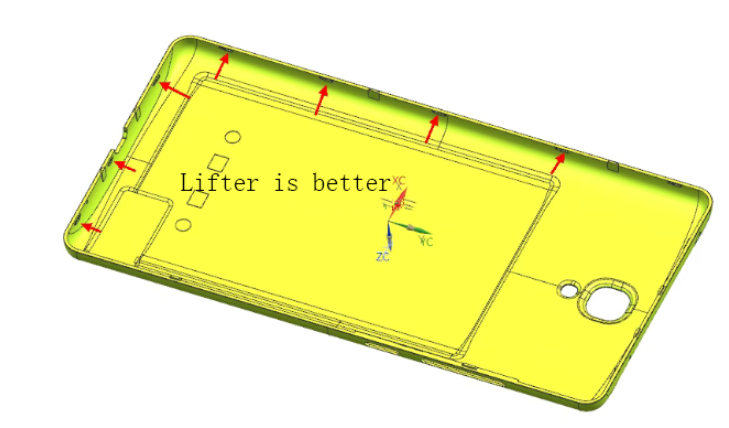
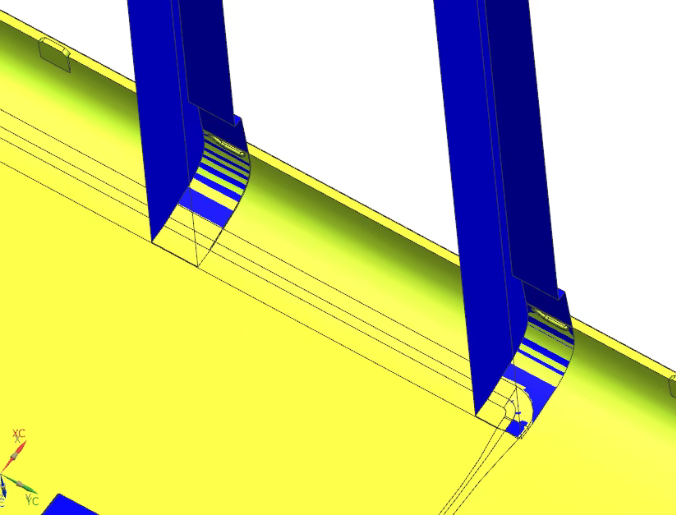
When you receive a product drawing with undercuts, how do you decide whether to use a lifter or a slider? This article explains exactly where lifters work best and how to choose – based on real‑world shop‑floor logic. Read it and apply it immediately.
1. First, understand the core function of a lifter
A lifter = ejection direction + inclined angle, accomplishing two tasks simultaneously:
(1) Eject the part for demolding
(2) Act as an internal/core side‑action for small undercuts
Lifter Characteristics:
– Simple structure, low cost
– Occupies little internal space in the mold
– Suitable for small, shallow, or internal undercuts
2. Five optimal real‑world scenarios for lifters
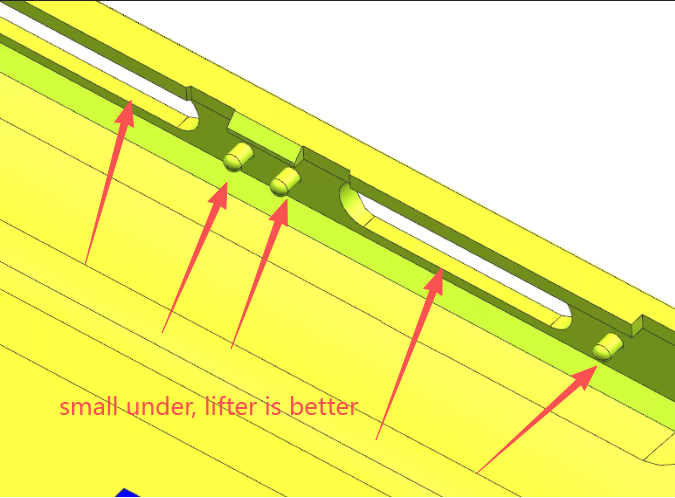
(1) Small internal undercuts (most common)
– Rib roots with undercuts
– Inner rib undercuts
– Small internal snaps or steps
Bottom line:For small internal undercuts, choose a lifter first.
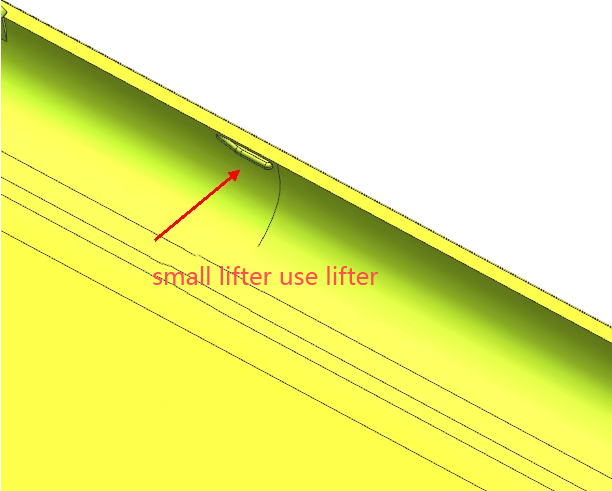
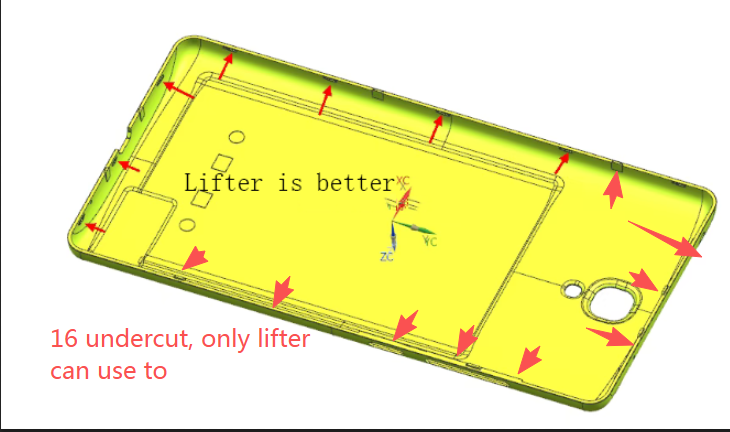
(2) Too little space for a slider
Small parts, dense structures, for some precision small case, no room for slider + angled pin + retaining block. Only a lifter fits as below picture shown
(3) Shallow undercut depth / short core‑pull distance
Typical shop experience:
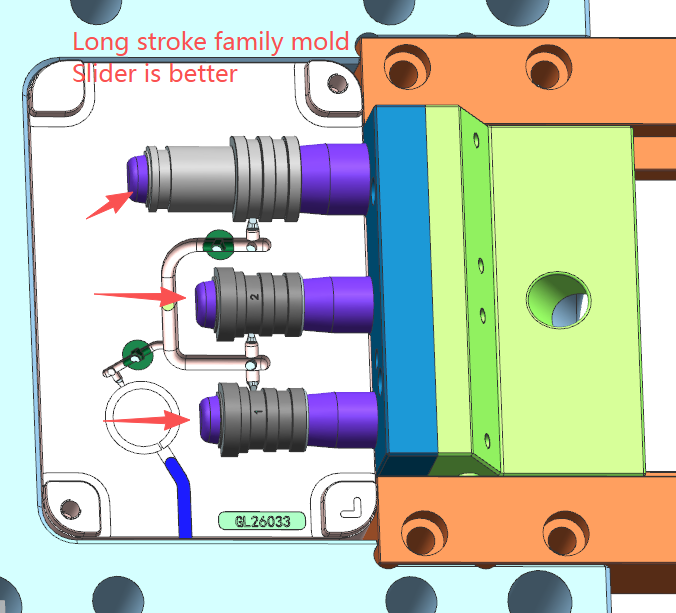
– Core‑pull distance ≤ 3–5 mm → lifter preferred
– Core‑pull distance > 5–8 mm → use lifter with caution; slider is better
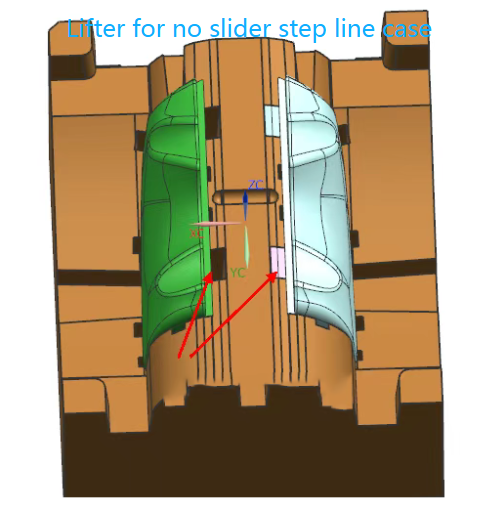
(4) A surface can not have a slider witness line
Housings, panels, transparent parts – a slider would leave witness lines or steps that customers reject. Use an internal lifter to keep the visible surface clean.
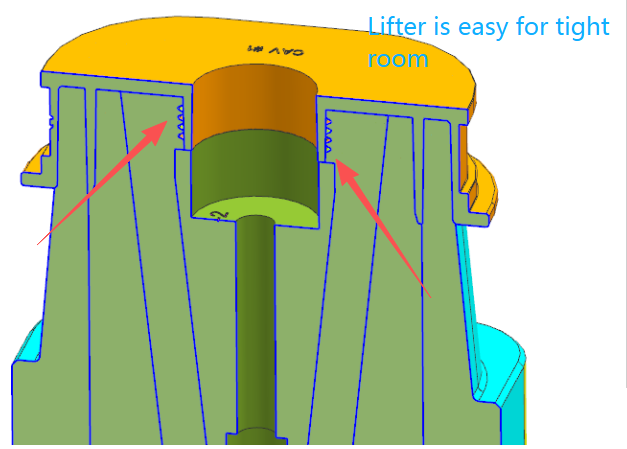
(5) Multi‑cavity / high‑density layouts
Many cavities with tight spacing make sliders difficult to arrange. Lifters save space and balance more easily.
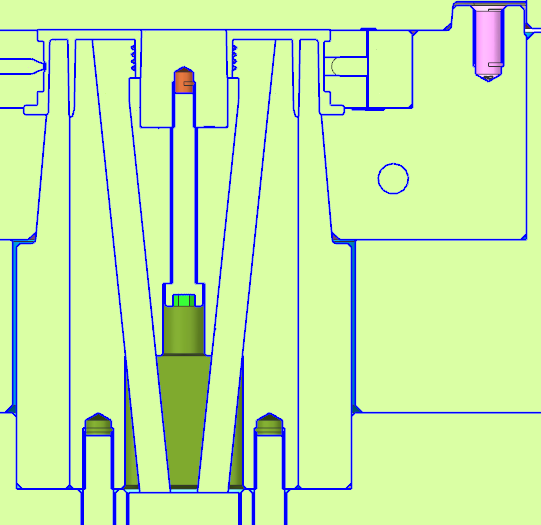
3. Scenarios where lifters are absolutely NOT suitable (critical pitfalls)
(1) Too deep an undercut / too long a core‑pull
The lifter angle is limited; too long leads to jamming or breakage.
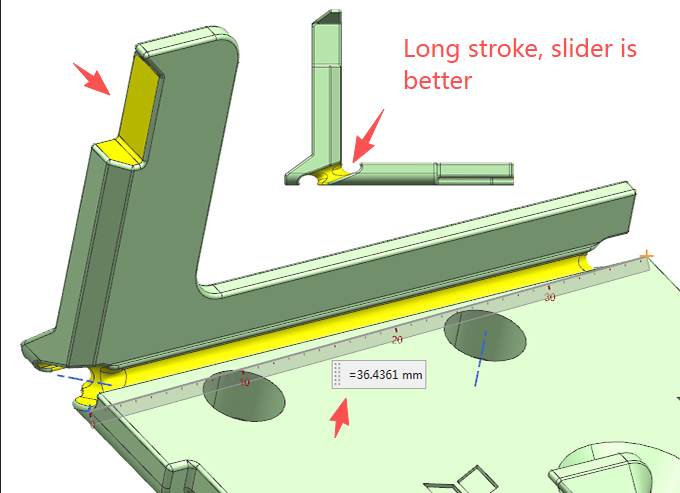
(2) Undercut on a large external surface
A lifter would require a large angle and Abecomes weak – use a slider.
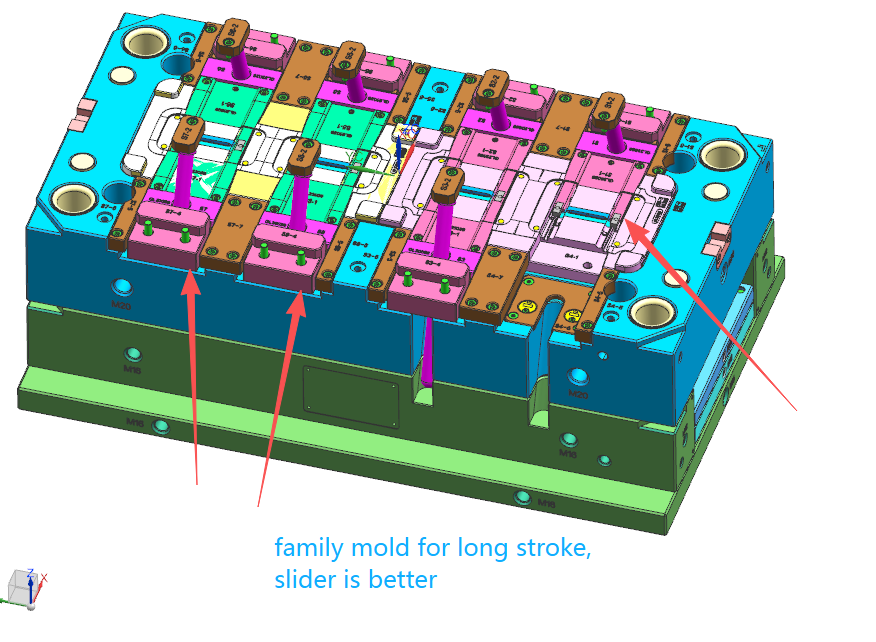
(3) Restricted lifter retraction space
Internal ribs or features block the lifter’s retreat path → consider a slider.
(4) The lifter retraction direction has a shut‑off surface (prone to flash) or requires a cavity lifter
Lifters are sliding components; if the retraction path includes a shut-off, wear and flash are likely.
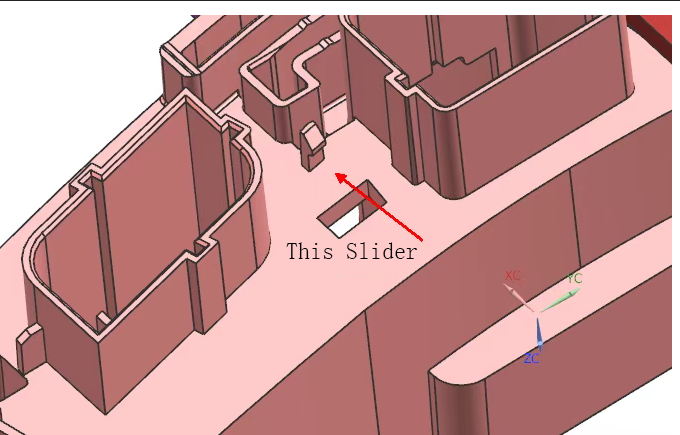
(5) Slider interference or poor cooling layout
Lifters steal space from cooling channels, leading to uneven cooling.
4. Practical decision rule: lifter vs. slider – how to choose?
Here is a “One-Second”shop-floor guideline:
| Condition | Recommendation |
| Undercut is internal, small, shallow → | Lifter |
| Undercut is external, large, deep → | Slider |
| A‑surface cannot have witness lines → | Lifter |
| Tight space, multi‑cavity → | Lifter |
| Long core‑pull, high forces, needs robust structure → | Slider (or hydraulic cylinder) |
| Deep + external + large → | Slider (or cylinder) |
Simple memory rule:
> Internal / small / shallow → lifter
> External / large / deep → slider
> Visible surface no mark → lifter
> High force / long stroke → slider
—
5. Practical tips for designers
(1) If a lifter can work, prefer it over a slider-saves cost, time, and reduces failure modes.
(2) When unsure whether a lifter is feasible, check in this order: core-pull distance → allowable angle → mechanical strength.
(3) Lifters hate: excessive angle, too long, too slender, ejector marks (white stress marks), jamming. Future articles will break down each of these issues.
Final takeaway
This guide gives you a direct, engineering‑based method to decide between a lifter and a slider. Use the rule of thumb, avoid the forbidden scenarios, and always check stroke, angle, and strength first. For most small internal undercuts – lifter wins. For large external undercuts – slider is the safe bet.